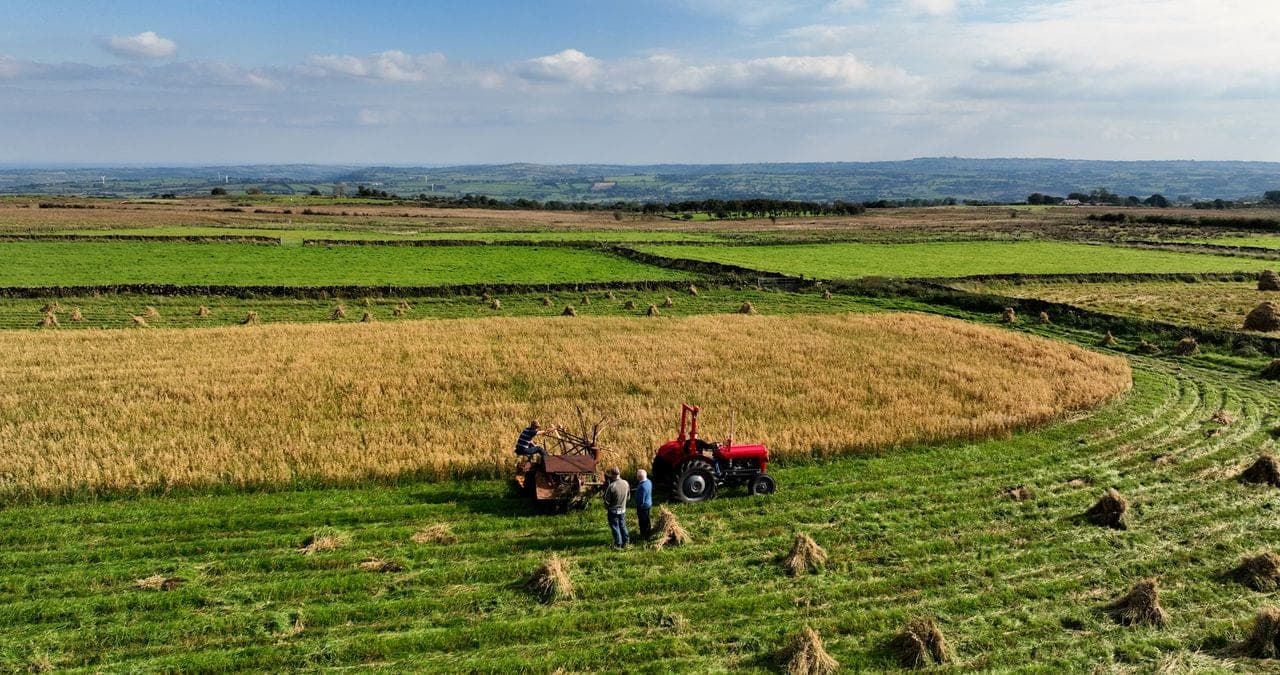
Farmers in Niger regrew 200 million trees, and nobody planted them
Cover art: VOTVS. Replace with original photography where available.
No plantation, no nursery, no aid project at the centre of it. Farmers stopped clearing the stumps already in their fields and let them come back — across millions of hectares, over roughly thirty-five years.
The standard way to talk about restoring a degraded landscape is to count seedlings. Pledges are announced in trees planted: a million, a billion. Photographs are taken of people with spades.
What happened in southern Niger involved almost none of that.
Farmers stopped clearing the stumps that were already in their fields, protected the shoots that came up from them, and pruned the results. Over roughly thirty-five years, that produced an estimated 200 million trees across at least 12 million acres, according to National Geographic's account of the research — and the researchers regard 200 million as a low estimate, with the area possibly nearer 15 million acres.
Nobody planted them. They were already there, underground.
Why the roots were still alive
This is the part that makes the whole thing work.
When land in the Sahel was cleared for farming, the visible trees went — but the root systems below did not die. They stayed alive, sending up shoots that were then cleared again each season as weeds, year after year.
The technique now called farmer-managed natural regeneration consists mostly of stopping. Choose the shoots worth keeping, protect them from grazing and from the next clearing, prune them so they grow into trees rather than bushes, and keep farming around them.
It costs a fraction of planting. And the survival rate is not comparable — a seedling from a nursery is a small plant with a shallow root system dropped into hostile ground, while a shoot from an established root system already has a decade of infrastructure beneath it.
How it was discovered
Not by the organisation that funded it, because there wasn't really one at the centre.
Gray Tappan, a geographer with the US Geological Survey, and Chris Reij, a Dutch forest scientist, began documenting it in 2004. They compared aerial photographs from 1957 and 1975 against satellite imagery and went to look on the ground.
The comparison showed something nobody had announced: across Maradi, Tahoua, Zinder and the area around Dan Saga, the tree cover in farmland had increased, substantially, over decades — in the middle of a region that global coverage describes almost exclusively in terms of desertification.
The change had been under way since the early 1980s. It took two decades for anyone outside to notice, because a landscape slowly regaining trees does not generate news.
What the trees did
What the regreening produced
Figures from National Geographic (April 2022), reporting research by Tappan, Reij and colleagues.
200m
trees regrown across southern Niger, treated by researchers as a low estimate
500,000t
extra cereal a year produced in tree-rich regions of southern Niger
2.5m
additional people that extra cereal could feed
Trees in a field are not decoration. They break the wind that strips topsoil and sandblasts seedlings, drop leaf litter that feeds the soil, and in the case of nitrogen-fixing species such as Faidherbia albida, fertilise the crop directly. One farmer told National Geographic his millet harvest went up fivefold.
There is a second effect that rarely makes the summary. Firewood came back within walking distance, and the hours women had spent collecting it were freed — in the accounts collected, going into producing medicines, oils and soap for income.
The honest limits
This is not a formula that can be pasted onto any degraded landscape, and the research says so.
A study in Scientific Reports in September 2020, led by Madelon Lohbeck, examined 316 plots in agroforestry parklands in Ghana and Burkina Faso and found what constrains regeneration. Grazing pressure and farming intensity suppress it. Crucially, there must be trees of the desired species nearby — regeneration cannot produce what has no seed source or surviving root stock. Where those preconditions fail, the paper concludes, natural regeneration has to be supplemented with actual planting.
That same paper puts Niger's revegetated area at more than 3 million hectares since the 1980s — a lower figure than the 12 million acres cited above, from a different method and a different year. We give both rather than picking the more impressive one.
- How many trees were regrown in Niger?
- Around 200 million, across at least 12 million acres of southern Niger, according to National Geographic's 2022 account of the research — and the researchers treat 200 million as a low estimate, with the area possibly closer to 15 million acres.
- What is farmer-managed natural regeneration?
- Letting trees regrow from the root systems and stumps already in a field, and protecting the shoots, instead of planting seedlings. The roots survive underground long after the visible tree is gone, so the regrowth is far cheaper and far more likely to survive than planting.
- Who documented the change?
- Gray Tappan, a geographer at the US Geological Survey, and Chris Reij, a Dutch forest scientist, from 2004 onwards — comparing aerial photographs from 1957 and 1975 with satellite imagery and field surveys.
- What difference did the trees make?
- National Geographic reported that tree-rich regions of southern Niger produce an extra half a million tonnes of cereal a year, enough to feed 2.5 million more people. Trees shelter crops from wind, add nitrogen and organic matter, and provide fodder, fuel and fruit.
كل رقم أعلاه مأخوذ من المصادر أدناه، كما أوردته، في التاريخ المذكور.
- 01How farmers in Earth's least developed country grew 200 million trees
National Geographic — 27 April 2022
- 02Drivers of farmer-managed natural regeneration in the Sahel. Lessons for restoration
Scientific Reports (Lohbeck et al.) — 14 September 2020
- 03Niger's re-greening revolution
World Agroforestry (CIFOR-ICRAF)
- 04Re-greening the Sahel: farmer-led innovation in Burkina Faso and Niger
United States Geological Survey
جرى التحقّق من الوقائع مقابل هذه المصادر بتاريخ 19 August 2026