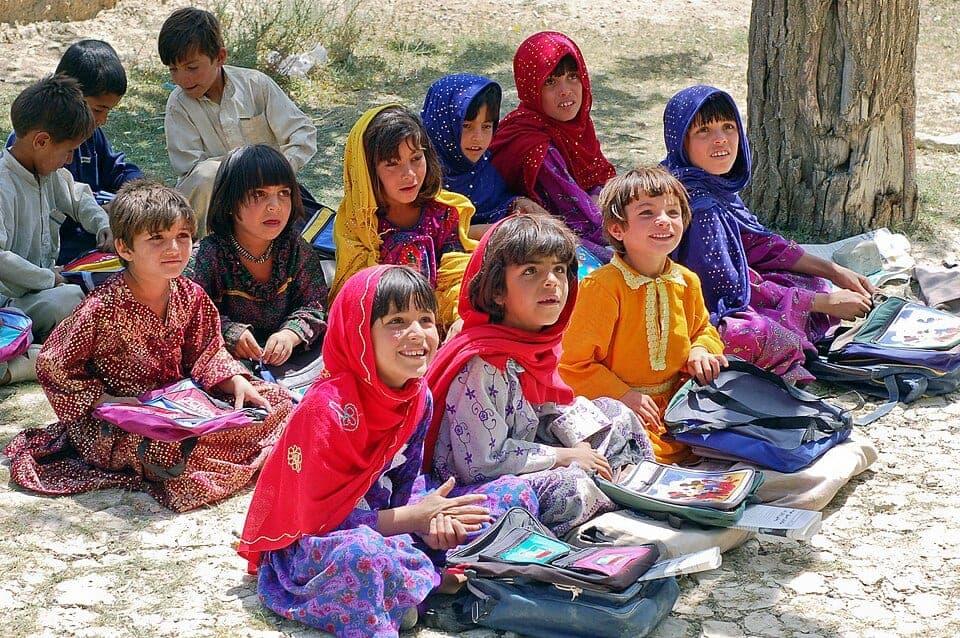
Afghanistan is the only country on earth that bans girls from school past primary level
Photo: Capt. John Severns, U.S. Air Force / via Wikimedia Commons, Public domain
Five years after the Taliban takeover, UNESCO counts 2.4 million girls shut out of secondary education and the UN counts more than 100 decrees restricting women's lives. UN Women calls it the world's most severe women's rights crisis.
Five years after the Taliban returned to power, the UN published an assessment of what has happened to Afghan women. The phrase it used was that they have been erased from public life.
Here are the figures behind that phrase.
What the numbers say
Afghan women and girls, five years on
UN News, 12 August 2026, drawing on UNESCO and UN Women. Movement figure is from women interviewed for the assessment.
2.4m
girls excluded from secondary education, per UNESCO
100+
decrees issued restricting education, work and movement for women
1 in 2
women interviewed who leave home only once or twice a month
UNESCO describes Afghanistan as the only country in the world that formally prohibits education for girls and women beyond primary level. Other countries have lower enrolment. Afghanistan is the only one where the ban is policy.
The restrictions are cumulative, and they are recent
The restrictions did not all arrive in 2021. OHCHR's report of 30 March 2026, covering August 2025 to January 2026, lists measures that are months old:
- Women barred from UN premises since September 2025
- Female civil servants — who had been receiving a reduced salary — terminated in January 2026
- Women banned from medical institutes since December 2024, with medical graduation exams held without female candidates
- Women's books removed from libraries and bookstores; teaching of human rights and gender studies prohibited
Volker Türk, the UN High Commissioner for Human Rights, presented the report, which says the human rights situation continues to deteriorate dramatically.
The second-order arithmetic
The consequences do not stop at the classroom door.
UNICEF has warned that restrictions on girls' education and women's employment could cost Afghanistan more than 25,000 female teachers and health workers by 2030.
Many Afghan women cannot be treated by a male doctor, so fewer female health workers means fewer women treated at all. The UN's assessment already records higher rates of maternal death, child marriage and gender-based violence.
The aid cuts land here too
Afghanistan sits in the lower group of the UN's 2026 prioritisation — one of the responses with less than half of its assessed needs inside the priority tier.
OHCHR's report records roughly 21.9 million people — about 45 per cent of the population — in need of humanitarian assistance, and nearly three million Afghans returned from neighbouring countries during 2025, a return movement arriving into an economy that cannot absorb it.
And within that shrinking response, one category of organisation was hit hardest. Nearly three-quarters of the women-led organisations surveyed for the UN's assessment reported funding cuts in 2025.
Those organisations are often the only ones able to reach Afghan women, since male aid workers frequently cannot.
- How many Afghan girls are out of school?
- UNESCO counts 2.4 million girls excluded from secondary education, reported in August 2026. UNESCO describes Afghanistan as the only country in the world that formally prohibits education for girls and women beyond primary level.
- What restrictions do Afghan women live under?
- The UN has documented more than 100 decrees issued since 2021 restricting women's education, employment and movement. OHCHR's March 2026 report records women barred from UN premises since September 2025, female civil servants terminated in January 2026, and women banned from medical institutes since December 2024.
- How restricted is Afghan women's movement?
- Half of the Afghan women interviewed for the UN's five-year assessment said they leave home only once or twice a month, with growing numbers reporting they feel unsafe going out without a male guardian.
- How is the aid crisis affecting Afghan women specifically?
- Nearly three-quarters of the women-led organisations surveyed reported funding cuts during 2025 — the same organisations best placed to reach women when male aid workers cannot.
Every figure above comes from the sources below, as they reported it, on the date given.
- 01Five years after Taliban takeover, Afghan women 'erased from public life'
UN News — 12 August 2026
- 02UNESCO says 2.4 million Afghan girls denied access to further education
Al Jazeera — 11 August 2026
- 03Report — Afghanistan's human rights situation 'continues to deteriorate dramatically'
UN Office of the High Commissioner for Human Rights (OHCHR) — 30 March 2026
- 04
Facts verified against these sources on 18 August 2026