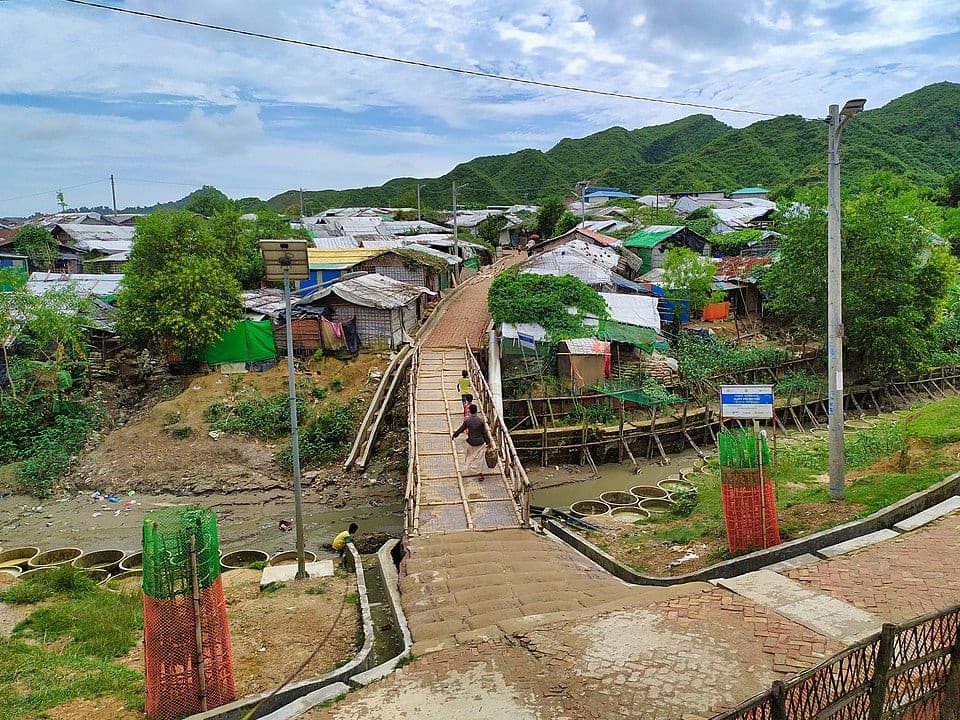
Photo: Rocky Masum / via Wikimedia Commons, CC BY-SA 4.0
From 1 April 2026, food assistance for 1.2 million Rohingya refugees in Bangladesh was split into tiers. Bangladesh's own refugee commissioner disagreed with the framing.
On 1 April 2026, the World Food Programme changed how it feeds 1.2 million people.
Until that day, a Rohingya refugee in the camps around Cox's Bazar received a voucher worth $12 per person per month. From that day, the amount depended on an assessment of how badly off the household was: between $7 and $12.
WFP described the change as a move to a tiered system based on need, not a ration cut.
Bangladesh's Refugee Relief and Repatriation Commissioner told the Associated Press that a ration cut is precisely what it means for the Rohingya.
What the tiers look like
Monthly food voucher per person, from 1 April 2026
Associated Press, 1 April 2026. The lower tier applies to roughly 17 per cent of refugees; around a third assessed as extremely food insecure remain on the full amount.
- Lowest tier7$
- Highest tier (extremely food insecure)12$
Seven dollars a month is about 23 cents a day. It is intended to be a household's entire food budget, in a camp where refugees are not permitted to work.
The reason is not local
The Associated Press reported that WFP lost about a third of its funding after foreign aid cuts by the United States and other donors. Its Rohingya operation was around 50 per cent funded in 2025, and 19 per cent funded at the time of the April reporting.
That figure is the whole story. An agency at 19 per cent of its requirement is not choosing between good options. It is choosing which people to give less to.
The Rohingya response in 2026
Figures from Associated Press (1 April 2026) and UN News (2 June 2026).
1.2m
Rohingya refugees in Bangladesh, including some 150,000 who arrived since early 2024
$710.5m
requested in the 2026 appeal — 26 per cent below the 2025 request
~900
Rohingya dead or missing at sea in 2025, the deadliest year on record for these crossings
Nine years, and the exits are closing
The camps at Cox's Bazar are approaching their ninth year. About 750,000 people crossed from Myanmar's Rakhine State in the influx that began in August 2017, joining Rohingya who had fled earlier.
Three routes out have narrowed at once.
Return. Repatriation prospects have receded as conflict inside Myanmar continues. There is no safe place to send people back to, and no authority to send them back to.
Work. Refugees have limited legal opportunity to earn inside Bangladesh, which is why a voucher is a household's food supply rather than a supplement to it.
Sea. In 2025, close to 900 Rohingya died or went missing attempting crossings in the Andaman Sea and Bay of Bengal — the deadliest year on record for that route.
When rations fall, that third route gets busier. This is not speculation; it is the pattern humanitarian agencies have documented after previous cuts.
Who is asked to absorb the cut
Bangladesh has hosted this population for nearly a decade, largely without the international burden-sharing that was promised at the start. UNHCR's spokesperson credited that hosting directly when warning about the 2026 shortfall.
The 2026 appeal asks for $710.5 million for refugees and Bangladeshi host communities — 26 per cent less than the 2025 ask. As with the global appeal, the smaller number does not describe smaller need. It describes lowered expectations of donors.
The people being asked to absorb the difference are a refugee household deciding what to stop buying, and a Bangladeshi district that has already carried nine years of this.
- How much food assistance do Rohingya refugees in Bangladesh receive?
- From 1 April 2026 the World Food Programme moved to a tiered system of US$7 to US$12 per person per month, replacing a flat US$12. About 17 per cent of refugees receive the US$7 minimum, and roughly a third assessed as extremely food insecure continue to receive US$12, according to Associated Press reporting.
- Why were Rohingya food rations changed in 2026?
- Funding. WFP lost about a third of its funding following foreign aid cuts by the United States and other donors. Its Rohingya operation was around 50 per cent funded in 2025 and 19 per cent funded at the time of the April 2026 reporting.
- How many Rohingya refugees are in Bangladesh?
- About 1.2 million, according to UN News in June 2026 — including roughly 150,000 who arrived since early 2024. Around 750,000 fled Myanmar's Rakhine State in the influx that began in August 2017.
- How much is the 2026 Rohingya appeal?
- US$710.5 million, covering refugees and Bangladeshi host communities — 26 per cent less than the 2025 request.
Every figure above comes from the sources below, as they reported it, on the date given.
- 01Food assistance slashed for hundreds of thousands of Rohingya refugees trapped in Bangladesh camps
Associated Press, via NPR — 1 April 2026
- 02UN urges world not to forget Rohingya refugees as aid cuts threaten vital support
UN News — 2 June 2026
- 032025–26 Joint Response Plan for the Rohingya Humanitarian Crisis
Rohingya Response (UNHCR / IOM inter-agency) — 2026
Facts verified against these sources on 18 August 2026